
 Essential Takeaways
- White sand for landscaping provides designers with a bright, neutral ground surface that suits modern, minimalist outdoor spaces.
- Washed white sand works across commercial, municipal, and residential projects, from courtyards and pool surrounds to playgrounds and inland beaches.
- Its free-draining, low-maintenance nature suits dense urban sites with water and labor constraints.
- Light-colored sand reflects more solar energy and runs cooler than dark aggregate or asphalt.
- Clean, washed sand reduces pressure on natural river sand, supporting more sustainable material choices.
Pick the wrong ground-surface material for a modern courtyard, and the problem shows up fast. The clean, minimalist look you wanted turns patchy, weeds creep through the gaps, and water pools after every Florida storm. White sand for landscaping has become a go-to choice for designers seeking a bright, contemporary feel without the upkeep of turf. The way you choose and place it determines whether an outdoor space reads as calm and polished or messy and dated within a given season.
Why Designers Choose White Sand for Modern Outdoor Spaces
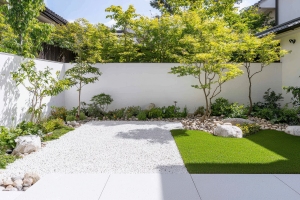
The pull is mostly visual. A bright, uniform white surface reads clean and current, which is why it shows up so often in modern landscape design and minimalist schemes built around texture and contrast more than dense planting. Against that pale ground plane, sculptural stones, succulents, cacti, and specimen trees stand out sharply, so the few elements you do place carry more weight. Grain size shapes the effect too. Finer, more powdery white sand reads soft and beach-like, while a slightly coarser grade gives more texture underfoot.
Designers also use raked white sand to suggest water in Zen or Japanese-style gardens, drawing ripple patterns across the surface without a single drop of actual water. Around pools, a band of white sand softens the hard edges of concrete or tile and gives compact urban yards a resort feel. For a consistent, refined finish, decorative landscaping sand such as White Prestige Sand retains its color and grading better than unscreened material, so the look stays even throughout the installation.
Where Landscape White Sand Fits in Urban and Commercial Projects
 Landscape white sand earns its spot because it works at almost any scale. In civic and resort settings, it builds inland or artificial beaches that bring a coastal feel to dense, landlocked sites. Municipalities and developers use it for playgrounds, sports areas, volleyball courts, and golf bunkers, where the soft texture and clean appearance matter for both safety and looks.
Smaller residential and hardscape jobs also lean on it. White sand fills the joints between pavers, stones, and bricks for a uniform finish that cuts weed growth, and it works as a topdressing for artificial lawns. Residential designs use it in mini-golf areas, seating zones, and decorative borders that pop against greenery, and it doubles as a flexible surface for event spaces that change use through the year. It also pairs well with decorative gravel, and the right pick often comes down to the path itself. White sand and white gravel each suit different walkways, so matching the material to the traffic and grade keeps a design looking sharp longer.
Low-Maintenance Benefits That Suit Dense City Sites
Urban projects live under tight water and labor limits, and white sand answers both. It requires no mowing or pruning and far less irrigation than turf, making it practical for plazas, courtyards, and street-level spaces that crews cannot tend every week.
Drainage is the other draw. Free-draining ground surfaces pull rainfall down into the soil and keep it from sheeting across hardscape, the same principle behind the permeable surfaces the EPA promotes for urban stormwater control. That keeps puddles away from paths, seating, and play zones after heavy rain. White sand also runs cooler underfoot than dark materials, since light, reflective surfaces bounce back more solar energy, a real benefit in Florida’s long, hot summers. In narrow courtyards, that brightness reflects more daylight into the space and helps bring focal points, such as a single tree or a piece of public art, into sharper focus.
How Material Choice Shapes Sustainability and Long-Term Value
Material selection now carries a sustainability weight that owners and specifiers track closely. Pressure on natural river sand has pushed the market toward clean, washed sand products with controlled quality. UN Environment Programme research flags sand as the second-most-extracted solid material after water and warns that river and coastal mining drive erosion and habitat loss, which is part of why washed and processed white sand has gained ground.
There is a design payoff too. Pairing white sand with gravel and crushed stone shrinks lawn area, cuts water use, and supports low-input planting that holds up in a hot climate. Designers and specifiers increasingly want urban landscaping materials that look good and perform well without a high environmental cost. White sand’s durability and clean processing put it on that short list. For larger builds, sustainable sourcing decisions affect cost and performance as much as appearance, so the material you specify shapes both the look and the long-term value of the space.
Get the Right White Sand for Your Project With Barclay Earth Depot
 Barclay Earth Depot’s team brings more than 80 years of combined excavation experience and Florida-specific material knowledge to help designers, contractors, and developers pick the right sand for modern outdoor spaces. As a women-owned supplier operating since 2007, we match material grade and color to your project so the finished space performs and looks the way you planned. Contact us today at (941) WE-DIG-IT or online to source white sand built for Florida conditions.