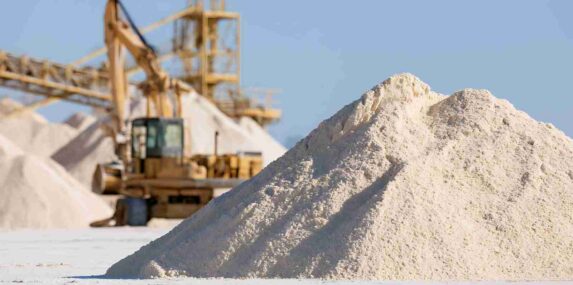
Essential Takeaways White sand belongs on high-end residential and commercial jobs where brown or yellow sand would flatten the design intent. White Prestige Sand is washed and screened in house to a fine, consistent grain, so gradation holds from one load to the next. Low mud content and few clay lumps keep the material stable […]
Blog
The Role of Reflective Ground Cover in Urban Heat Mitigation

Essential Takeaways Asphalt, wood mulch, and other dark surfaces can reach temperatures of 120 to 150 degrees Fahrenheit. Light-colored quartz sand stays cool by reflecting solar radiation rather than absorbing it. Albedo measures how much solar energy a surface reflects. It is the difference between heat-reducing ground cover and heat-trapping ground cover. White quartz sand […]
How White Sand for Landscaping Shapes Urban Design Trends

Essential Takeaways White sand for landscaping provides designers with a bright, neutral ground surface that suits modern, minimalist outdoor spaces. Washed white sand works across commercial, municipal, and residential projects, from courtyards and pool surrounds to playgrounds and inland beaches. Its free-draining, low-maintenance nature suits dense urban sites with water and labor constraints. Light-colored sand […]
8 Tips To Avoid Concrete Cracks With Quality Aggregates

Essential Takeaways Aggregate fills 60 to 75% of concrete volume, so its quality controls strength, shrinkage, and crack resistance more than any other ingredient. Clean, well-graded aggregates reduce a mix’s water demand, thereby reducing shrinkage cracking. Angular crushed stone provides high compressive strength for structural work, while properly sized maximum cuts reduce paste volume and […]
Maintaining Sand-Based Outdoor Areas for Commercial Use

Essential Takeaways Washed, rounded sand with uniform grain size performs best on commercial playgrounds, volleyball courts, and recreation spaces. Routine raking, sifting, and depth checks prevent compaction, contamination, and safety violations. A properly built base of gravel and geotextile fabric protects drainage and slows sand migration. Florida heat, humidity, and rainfall require scheduled top-offs to […]
Crushed Stone Selection for Industrial Driveways and Paths

Essential Takeaways Angular crushed stone interlocks under compaction, giving industrial sites better load-bearing capacity than rounded gravel. A three-layer system of subbase, base, and surface stone distributes heavy axle loads through the structure instead of into the subgrade. ASTM D448 grades such as #3, #57, and #411 each have a specific role in driveway and […]
Sustainable Sand Use for Florida Commercial Infrastructure Projects

Essential Takeaways Sand is the most extracted solid material on the planet, and unsustainable sourcing damages Florida’s rivers, wetlands, and coastlines. Local sourcing reduces transportation emissions and meets FDOT gradation requirements without additional processing. Recycled materials such as shell aggregate can replace virgin sand in concrete and asphalt without reducing strength. Proper gradation, lift thickness, […]
How To Use Sand Aggregate for a Level and Long-Lasting Paver Patio

Essential Takeaways Sand aggregate works as a leveling course between the compacted gravel base and your pavers. A one-inch layer of sharp or concrete sand creates the foundation for an even paver surface. Compacting the road base in 2 to 3-inch lifts prevents settling and shifting later. Polymeric sand in the joints stops weed growth, […]
Identifying Concrete Failures From Impure Aggregates

Essential Takeaways Impure aggregates produce specific, diagnosable failures, including map cracking, popouts, scaling, and surface dusting on sand aggregate. Silt and clay above acceptable limits reduce compressive strength and create porous concrete prone to water damage. Organic and hydrocarbon contamination can cut concrete compressive strength by 12% to 28%. On-site stockpile inspection catches contamination through […]
