 Essential Takeaways
- White Prestige Sand comes from Florida’s Lake Wales Ridge, formed 2 million years ago as ancient island chains emerged from the water.
- Processing removes clay and impurities through hydraulic washing, cyclone separation, and rotary drying to reduce slurry moisture to under 1%.
- Florida’s premium white sand contains 98-99% silica with construction-grade particle sizes typically ranging from 0.25mm to 2mm, meeting FDOT specifications.
- Transportation from Central Florida quarries to job sites involves truck hauling (22 tons per load), rail freight, or barge delivery, depending on project location.
- Mining operations require Florida DEP permits with extensive environmental monitoring, water quality testing, and mandatory reclamation plans.
Foundation failures from improper aggregate selection often do not appear until years after construction, usually starting with settlement cracks that expand as moisture cycles through sandy soil. White Prestige Sand avoids these problems because it comes from geological deposits that nature spent millions of years purifying.
The Lake Wales Ridge runs 100 miles through Central Florida’s Highlands, Polk, Osceola, Orange, and Lake Counties. This ridge represents what remained above water approximately 2 million years ago during the Pleistocene epoch, when the rest of Florida sat underwater. These ancient islands collected sediments that traveled from metamorphic rock formations in neighboring states, and the movement removed less stable materials through constant physical and chemical breakdown.
What survived was almost pure silica. The Pleistocene shoreline and beach dune system underwent intense weathering that further refined the deposits, leaving white sand with a silica content of 98-99%. You can see the ridge’s white sand deposits in satellite imagery because their purity creates a distinct coloration compared to the surrounding areas.
Extraction Methods That Protect Quality
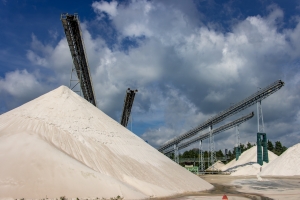
Most Central Florida operations use closed-loop hydraulic dredging. High-powered suction dredges (typically 500 horsepower or greater) pull unconsolidated sand from depths of 30 to 50 feet using 70-foot dredge ladders. These systems transport raw material as slurry directly to processing plants, preventing contamination from surface exposure.
The dredging terminates in fine to very fine white clayey sands at depth. In higher ridge areas where water-table restrictions apply, operations switch to dry excavation methods. However, hydraulic mining dominates because it handles the soft, unconsolidated deposits more efficiently than mechanical equipment.
For projects requiring beach-compatible sand, inland quarries such as Stewart Mining in Immokalee supply material when offshore sources run out. Trucks haul 22 tons per load to coastal sites, sometimes covering 30+ miles from the mine to the placement location.
Processing Steps That Remove Impurities
 Raw sand enters processing plants where hydraulic cyclones and vibratory screens separate construction-grade material from specialty products. Water washing comes first. Sand moves through vibrating screens and then into impeller wheel bucket washers that remove clay particles and organic matter.
Classification happens through screens with specific mesh sizes. The 8-16 mesh captures particles between 1.19mm and 2.38mm, while the 30-60 mesh handles the 0.297mm to 0.595mm range. This standardization establishes a consistent particle distribution in the finished product.
Attrition scrubbers provide aggressive particle-on-particle contact that liberates stubborn clays stuck to sand grains. This improves clarity and removes staining that would otherwise affect appearance in high-end applications such as pool finishes or architectural concrete.
Fine sand recovery uses high-capacity pumps pushing material through hydraulic cyclones, with recovered sand going to radial stackers. The system operates as a closed loop. Water withdrawn from the mine pit washes and sizes products, then returns for reuse. Waste materials get placed back in mined-out areas as part of reclamation requirements.
Drying Requirements for Construction Use
Dewatering screens reduce moisture from initial slurry levels down to approximately 10-15%, but construction specifications demand lower moisture content. Rotary dryers use heated cylinders with internal flights that lift and cascade sand through air streams at 80°C to 200°C.
Single-drum, double-drum, or three-pass configurations handle different capacity requirements. Industrial operations process anywhere from 1.9 to 76 tons per hour, bringing final moisture content down to 0.5-1% or less, depending on what the application requires.
Natural gas provides cleaner heating than coal or diesel alternatives. PLC control systems monitor temperatures, moisture levels, and airflow in real time, making automatic adjustments when sensors detect variation from target specifications.
Quality Testing Before Material Leaves the Site
Florida Department of Transportation specifications require that 3% to 75% of particles fall between No. 16 and No. 30 sieves for general construction use. Sieve analysis involves passing samples through stacked wire mesh screens with decreasing openings, then weighing the retained material at each level to determine the particle size distribution.
Clay content is limited to 1% by weight for construction-grade sand, with total deleterious substances kept within FDOT specifications. Sedimentation analysis measures clay and silt content to verify compliance. Beach nourishment projects add Munsell color testing. Material must show moist color-value/chroma of 6/2 or lighter to match existing beach conditions.
Specific gravity typically ranges from 2.5 to 3.0 for construction-grade material. Simple permeability tests measure drainage time as water passes through sample containers, verifying that sand will compact properly and won’t retain excess moisture that can cause settlement problems.
Delivery to Your Construction Site
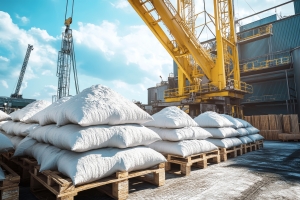
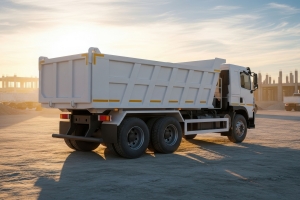 Truck transport dominates short-haul deliveries, with standard dump trucks carrying 22 tons per load. Large projects might move 10,000 tons daily through multiple trips, requiring GPS tracking and flexible scheduling to coordinate with construction timelines.
Rail freight becomes cost-effective for bulk shipments over longer distances. Gondola cars and hopper cars handle aggregate loads through Florida’s rail network, with receiving locations transferring material to trucks for final delivery.
Barge transportation works when projects have waterway access. Terminals load material directly onto vessels that deliver to coastal construction sites or inland locations along navigable rivers. Professional hauling companies maintain fleets exceeding 250 owner-operators to handle scheduling demands for significant developments.
Get Florida-Sourced White Prestige Sand From Barclay Earth Depot
Barclay Earth Depot sources premium White Prestige Sand from Central Florida’s Lake Wales Ridge deposits and works with Florida-permitted operations that meet FDEP environmental standards. Our team’s 80+ years of combined excavation experience helps contractors match sand specifications to project requirements, whether you need material for concrete work, masonry applications, or specialty finishes. Contact us today at (941) WE-DIG-IT or online to discuss delivery scheduling and technical specifications for your next Florida construction project.