

Essential Takeaways
- Fine white sand requires 95% minimum silica dioxide content for classification, providing superior chemical stability.
- FDOT Section 902 specifications mandate precise gradation tolerances with fineness modulus variation limited to 0.20 from the target.
- Concrete mixes using fine white sand show compressive strength increases between 5-29% compared to river sand.
- Lakeland’s acidic soil and 53-inch annual rainfall demand materials with enhanced moisture resistance and chemical durability.
- Rounded quartz particles improve concrete workability by increasing slump and creating better void-filling between larger aggregates.
When concrete fails prematurely, the problem often begins with aggregate selection. Engineers spec materials based on availability rather than performance characteristics, which means that the sand you choose determines whether your concrete maintains its integrity through Lakeland’s moisture cycles and acidic soil exposure. Fine white sand delivers measurable performance advantages in compressive strength and chemical resistance, but these benefits depend entirely on understanding the material science underlying silica composition and particle grading.
High Silica Content Creates Measurable Strength Improvements
Quality fine white sand is defined by its silica dioxide concentration. To qualify as true silica sand, materials need 95% minimum SiO2 content, and this purity level directly affects how concrete performs under compression loads. This high silica content delivers exceptional hardness and chemical stability compared to conventional aggregates.
Research on concrete mixtures shows that replacing river sand with fine white sand increases compressive strength by 5-29% without any negative durability effects. This improvement occurs because white sand particles pack more efficiently, resulting in a denser, stronger concrete mix.
And the strength gains aren’t theoretical. Lakeland’s rapid growth means you’re building for long-term performance, with population increases of 2.30% annually putting pressure on infrastructure that needs to last decades. The city’s nearly $78 million Western Wastewater Trunkline Project shows the scale of construction activity, which is why material selection affects both immediate project success and long-term maintenance costs.
FDOT Standards Define Performance Through Gradation Control
 Florida Department of Transportation Section 902 specifications establish exact gradation requirements that determine whether sand performs consistently across batches. The standards require naturally occurring quartz grains that meet specific sieve retention percentages, starting with 95-100% passing through a No. 4 sieve and ending with a maximum 4% passing the No. 200 sieve.
The fineness modulus tolerance is also essential. FDOT permits only a 0.20 variation from the target gradation, which means suppliers must maintain strict quality control to prevent rejection. This precision establishes that concrete behaves predictably during mixing and placement, so you get the workability characteristics your project requires.
FDOT also tests for organic impurities using a colorimetric test. If the color is darker than the standard, the material is rejected unless testing proves the impurities won’t harm the concrete. Deleterious substances are also strictly limited, meaning that shale, coal, lignite, cinders, clinkers, and clay lumps combined can’t exceed specific percentages that would weaken the final product.
Particle Shape and Size Distribution Affect Concrete Workability
The rounded particle geometry of fine white sand changes how concrete flows during placement. Angular crushed stone creates friction between particles, reducing slump and making the mixture harder to work with. Rounded quartz grains from natural weathering processes slide past each other more easily, increasing workability without adding extra water that would compromise strength.
This improved flow results from the particle-size distribution filling the voids between larger aggregates. Fine particles occupy spaces that would otherwise remain empty, creating denser concrete with fewer weak points. The void-filling effect also reduces the cement paste required to coat all surfaces, thereby lowering material costs while maintaining or improving strength characteristics.
Testing protocols follow ASTM C136 for fineness modulus determination and ASTM C33 for aggregate standards. These standardized methods let engineers compare materials across suppliers and verify that sand meets project specifications before concrete production begins.
Lakeland’s Climate Demands Chemical-Resistant Aggregates
Lakeland’s USDA zone 9b/10a classification means 240 sunny days annually, combined with an average of 53 inches of rainfall. This creates constant moisture cycling that tests material durability year after year. Florida’s acidic soil conditions pose an additional challenge, as limestone-rich aggregates degrade more rapidly in low-pH environments.
Silica-based materials resist chemical attack better than alternatives. The high purity prevents reactions with acidic groundwater, which would otherwise weaken concrete over time. Given that coastal salt air can penetrate inland in Florida, corrosion resistance is important even for projects that aren’t directly on the coast.
Moisture resistance extends infrastructure lifespan by preventing weathering damage that manifests as surface scaling, spalling, or internal cracking. When concrete maintains its structural integrity through repeated wet-dry cycles, you avoid the expensive repairs that come from using aggregates that can’t handle environmental stress.
Geological Origins Determine Material Quality
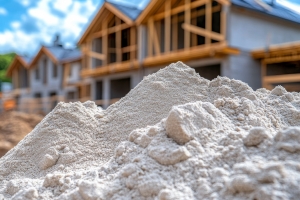 Fine white sand in Florida formed through millions of years of erosion from quartz-rich Appalachian Mountain rocks. Rivers transported these particles south, and continuous water action over 1,000 to 10,000 years created the rounded, smooth texture that improves concrete workability.
This natural sorting process removed softer minerals and impurities, leaving behind predominantly pure quartz grains. The geological formation explains why Florida’s white sand delivers consistent quality, since the material has already undergone natural filtration before mining operations began.
Processing adds another quality control layer. Washing with high-pressure water removes clay, silt, and dust, while vibrating screens separate particles by size. This combination of natural formation and mechanical processing produces sand that reliably meets FDOT specifications.
Get Performance-Grade Fine White Sand From Barclay Earth Depot
Barclay Earth Depot’s team understands how Lakeland’s climate and soil conditions affect aggregate performance, and our quality control processes establish that fine white sand consistently meets FDOT Section 902 specifications. Our wholesale supply operation serves developers, contractors, and landscapers throughout Central Florida with materials that deliver measurable strength improvements and long-term durability. Contact us today at (941) WE-DIG-IT or online to talk about your project requirements and source aggregates that meet engineering specifications for Florida construction conditions.