 Essential Takeaways
- Sand is the most extracted solid material on the planet, and unsustainable sourcing damages Florida’s rivers, wetlands, and coastlines.
- Local sourcing reduces transportation emissions and meets FDOT gradation requirements without additional processing.
- Recycled materials such as shell aggregate can replace virgin sand in concrete and asphalt without reducing strength.
- Proper gradation, lift thickness, and compaction prevent settlement, drainage failure, and pavement distress.
- Design optimization and asset longevity reduce sand demand throughout a project’s full life cycle.
A commercial pavement that settles two years after construction, or a foundation that cracks because the structural backfill was never compacted properly, usually traces back to the sand. Sustainable sand sourcing matters for environmental reasons. It also drives on-site performance, since material from poorly managed sites tends to fail to meet FDOT specifications and creates rework costs that dwarf any front-end savings. Here is how to source, place, and maintain sand for commercial infrastructure work in Florida.
Why Sustainable Sand Matters for Florida Commercial Projects
Sand is the most extracted solid material on the planet, according to a UNEP analysis. It feeds concrete, asphalt, utility bedding, drainage layers, and structural backfill across nearly every commercial build. Florida’s coastal geography makes the state especially sensitive to extraction pressure, since aggressive river and shoreline mining accelerates erosion, degrades wetlands, and weakens the natural buffers that protect property during storms.
For FDOT and industrial work, environmental sourcing connects directly to performance. Material from poorly managed sites exhibits inconsistent gradation, contaminants, and quality issues that later manifest as settlement or pavement distress. Sustainable sand sourcing means working with suppliers who can document where the material came from, how it was processed, and how it tests against state specifications.
Sourcing Eco-Friendly Construction Materials
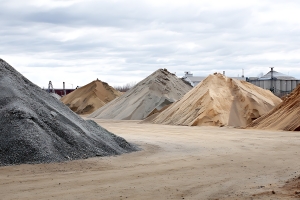 The biggest sustainability gains on commercial sand supply come from where the material is sourced. Local sources cut transport emissions and the fuel cost that goes with long-haul trucking. Regional bulk sand suppliers also tend to meet FDOT gradation requirements without extra processing, since they calibrate operations around state specs.
Recycled and environmentally friendly aggregates expand the options. Shell aggregate, for example, is a by-product of Florida’s oyster farming industry that would otherwise go to landfill. It can replace fine or coarse aggregate in concrete and asphalt without reducing compressive strength, and it works well for road bases, drainage layers, and pathways. Recycled crushed concrete and asphalt serve many subbase and fill applications, too, provided the material is tested for contaminants and gradation.
Documentation closes the loop. Owners pursuing ESG goals or LEED certification need a paper trail showing extraction site information, recycled content percentages, and quality test results. Suppliers who deliver that paperwork make construction sand sourcing simpler for procurement.
Best Practices for Placement and Compaction
Sustainable sand only performs as well as the placement work behind it. The right material laid down wrong still fails.
Gradation has to match the application. Pipe bedding, structural backfill, drainage layers, and concrete sand all have different particle-size requirements. Using a single product across all of them creates voids in some areas and over-compaction in others, leading to utility failures, trench settlement, or pavement cracking. Specifying the right gradation up front and verifying it with each delivery prevents most installation problems.
Compaction in proper lifts comes next. Sand and aggregate layers should be placed in lifts thin enough to compact fully, then tested for density before the next lift goes down. Skipping density checks to save time on the schedule is an expensive shortcut, since rework after failure costs more than the original placement.
When recycled materials enter the mix, quality control matters even more. Moisture content, contaminant checks, and gradation testing should run on every load. This applies to sustainable building materials and is what allows recycled aggregates to perform on par with virgin sand in commercial applications.
Designing To Cut Long-Term Sand Demand
 Material efficiency on the design side reduces overall consumption across a project’s life. The simplest opportunity is avoiding overdesign. Many commercial specifications specify conservative material thicknesses that exceed those required by FDOT or industry best practices. Reviewing specs against real loading and site conditions often allows for thinner subbase or backfill sections without losing performance.
Asset longevity matters just as much. Pavements, foundations, and drainage systems that get inspected and rehabilitated on schedule last decades longer than those patched reactively. Each year of additional service is a year you do not have to mine, process, and haul replacement material.
Reuse plays a role, too. Dredged sediment from Florida ports and waterways can sometimes be repurposed for fill or beach renourishment, reducing reliance on newly mined sand. On smaller commercial sites, on-site stockpiling and reuse of excavated material cut transportation and disposal costs. For FDOT projects, reused material must be tested and certified to meet project specs before it is returned to use.
Source Sustainable Sand for Your Next Commercial Project From Barclay Earth Depot
Sustainable sand sourcing affects cost, schedule, performance, and ESG outcomes all at once. Working with a supplier that knows FDOT specifications, documents material sourcing, and offers locally produced and recycled options simplifies the whole process. Barclay Earth Depot supplies bulk sand, shell aggregate, and rock aggregate to commercial and industrial sites across Central Florida, with documented sourcing and quality testing built into every load. Contact us today at (941) WE-DIG-IT or online to discuss your material requirements and arrange bulk sand delivery on a schedule that fits your project.