
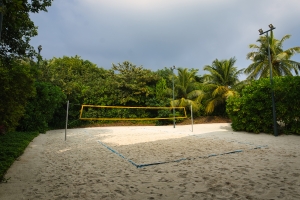
 Essential takeaways
- A standard sand volleyball court for doubles measures 26’3″ by 52’6″, with a minimum free zone of about 10 feet on all sides, for a total footprint of roughly 46’ by 72′.
- Orient the court lengthwise, North to South, so players aren’t staring directly into the sun during morning and evening games.
- Sand selection determines both player safety and court longevity, so you need washed, low-clay bulk beach sand with particle sizes between 0.5mm and 1mm.
- A full-size court typically requires 110 to 200 tons of sand, depending on your dimensions and depth.
- Proper drainage underneath the sand is the single biggest factor separating a playable court from one that floods after every rainstorm.
A sand volleyball court that drains poorly is basically useless. You end up with compacted, muddy sand that takes days to dry, and players either slip on the surface or refuse to play on it altogether. From excavation depth and drainage pipe placement to choosing the right bulk beach sand, every early decision determines if your court holds up through years of heavy use or falls apart after one wet season.
Why Court Orientation and Sizing Matter More Than You Think
The standard competitive sand volleyball court for doubles play measures 26’3″ wide by 52’6″ long (8m by 16m). If you’re building for 4-player or 6-player sand formats, many recreational facilities use a 29’6″ by 59′ (9m by 18m) indoor court footprint. Per USAV, the free zone must be at least 10 feet (3 meters) on all sides of the court, and the buffer must be uniform around the entire perimeter.
For a standard doubles court, your total footprint is roughly 46 feet by 72 feet. For the larger 6-player format, you’re looking at about 49 feet by 79 feet. FIVB world and official competitions require an even larger free zone of 5 meters (roughly 16 feet) on all sides.
Best practice is to run the court lengthwise, North to South. An East-West layout means one team is blinded by the sun every morning, and the other is blinded every evening. It sounds minor until you’re trying to host a tournament and half the matches are unplayable during the first and last hours of daylight.
Also, check the area overhead. Tree branches and power lines above the playing surface will cause problems. And before you break ground at all, call your local utility locator service. Hitting a buried gas line or power cable turns a fun weekend project into something much worse.
How to Handle Excavation and Drainage
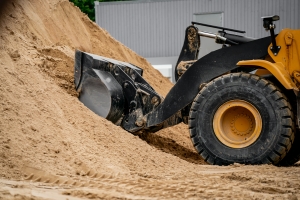 Excavate the full playing area to a depth of at least 12 inches. If your soil drains poorly or you’re in a region with heavy rainfall, you may need to go deeper to accommodate a gravel layer and drainage pipe below the sand. Pitch the base at a slight slope toward one end or corner, so water has somewhere to go, and dig a drainage ditch leading away from the court at that low point.
Install perforated drainage pipe in a zigzag pattern across the base, with the closed end at the highest point and the open end terminating at the lowest point. Lay the pipe with the perforated side facing down so water wicks in from the bottom and sides. Wrapping each section in landscape fabric before you set it down keeps sand and silt from clogging the perforations over time.
Once the pipe is down, spread 4 to 6 inches of gravel evenly over the base. Then roll out landscape fabric over the gravel. This barrier prevents your sand from filtering down into the drainage layer, which would reduce both drainage performance and your sand depth over time.
Setting Net Posts and Building the Perimeter
Set your net posts before filling the court with sand. Dig each post hole at least 3 feet deep and set the poles in concrete. Plumb each one in two directions and brace it firmly while the concrete cures, so it stays vertical. Net height is 7 feet 11⅝ inches for men and 7 feet 4⅛ inches for women, measured at the center of the net with the sand raked level.
For the perimeter, you need something that holds the sand in and keeps grass and dirt out. Concrete retaining wall blocks are durable and give a clean, finished appearance. Level each block individually and fill the center with gravel for stability. Pressure-treated 6×6 lumber is a more affordable option that still holds up well. Railroad ties work too, but they’re a safety hazard for players moving near the edges, so you’ll want to either pad them or establish a ground rule that treats them as out-of-bounds.
Choosing and Placing Your Bulk Beach Sand
Sand selection will make or break your court. You want washed bulk beach sand that’s free of clay, silt, and organic material. Clay content is the biggest enemy here because it causes the sand to compact and crust over when wet, which defeats the entire purpose of a sand court.
According to FIVB, the sand must be composed of fine, loosely compacted grains that have been sifted to an acceptable size. It can’t be too coarse, and it has to be free of rocks, shells, stones, and anything else that could cause cuts or injuries. But it can’t be too fine either, because overly fine sand creates dust and sticks to players’ skin. For official and world-level competitions, the sand depth must be at least 40 cm (roughly 16 inches).
Masonry sand is a popular choice because it’s low in clay and won’t crust over as easily as unprocessed material. The fine-grain cushions bare feet while still draining well after rain. However, you should always ask your supplier about the specific clay and silt content before committing to a large order. Sand that looks great dry can turn into a hard, packed surface after a few storms if the fines content is too high.
A full-size court typically requires between 110 and 200 tons of sand, depending on your exact dimensions and target depth. For most recreational and competitive applications, 12 to 18 inches of sand above the fabric layer provides a safe, playable surface. Spread it evenly with gravel rakes and check for consistent depth across the entire court. Low spots will collect water, creating soft zones that disrupt gameplay.
Matching the right grade to your specific use makes a real difference, and this breakdown of how different sand types perform across sports and landscaping applications can help you compare options.
Keeping Your Court Playable Long-Term
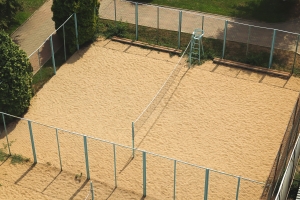 Once the court is built, regular maintenance keeps it performing the way it should. Rake the sand frequently to prevent compaction and redistribute material that shifts during play. Check the drainage system after heavy rainfall to confirm water isn’t pooling anywhere on the surface. ‘
Keep an eye on the perimeter for encroaching grass, and inspect the retaining wall or border material at least once a year for shifting or deterioration. If the sand picks up too much debris, organic growth, or clay contamination over time, you may need a partial or full sand replacement, depending on how heavily the court gets used.
Order Bulk Beach Sand for Your Volleyball Court From Barclay Earth Depot
Building a volleyball court is a big project, and the sand is the one material you absolutely cannot cut corners on. Barclay Earth Depot supplies bulk beach sand in the grades and volumes that volleyball court builds require, and our aggregate team can help you figure out the right tonnage and particle spec for your court dimensions. Contact us today at (941) WE-DIG-IT or online to get your order started.